The "Text Hip" Trend: How Pop Culture and Unlikely Brands Are Making Reading Cool Again
Coach is selling $95 charms shaped like Jane Austen novels. Dior put Dracula on a handbag. Strangers in New York line up to read silently together. Here's how reading became something people show off, not just do, and what authors and small presses can learn from it.
In this article
At New York Fashion Week this year, the most talked-about accessory in Coach's front row wasn't a bag. It was what was clipped to the bags: tiny books. Not props, either. Readable miniature novels with embossed spines and real pages, made with Penguin Random House and sold for $95 each. Some sold out within days.
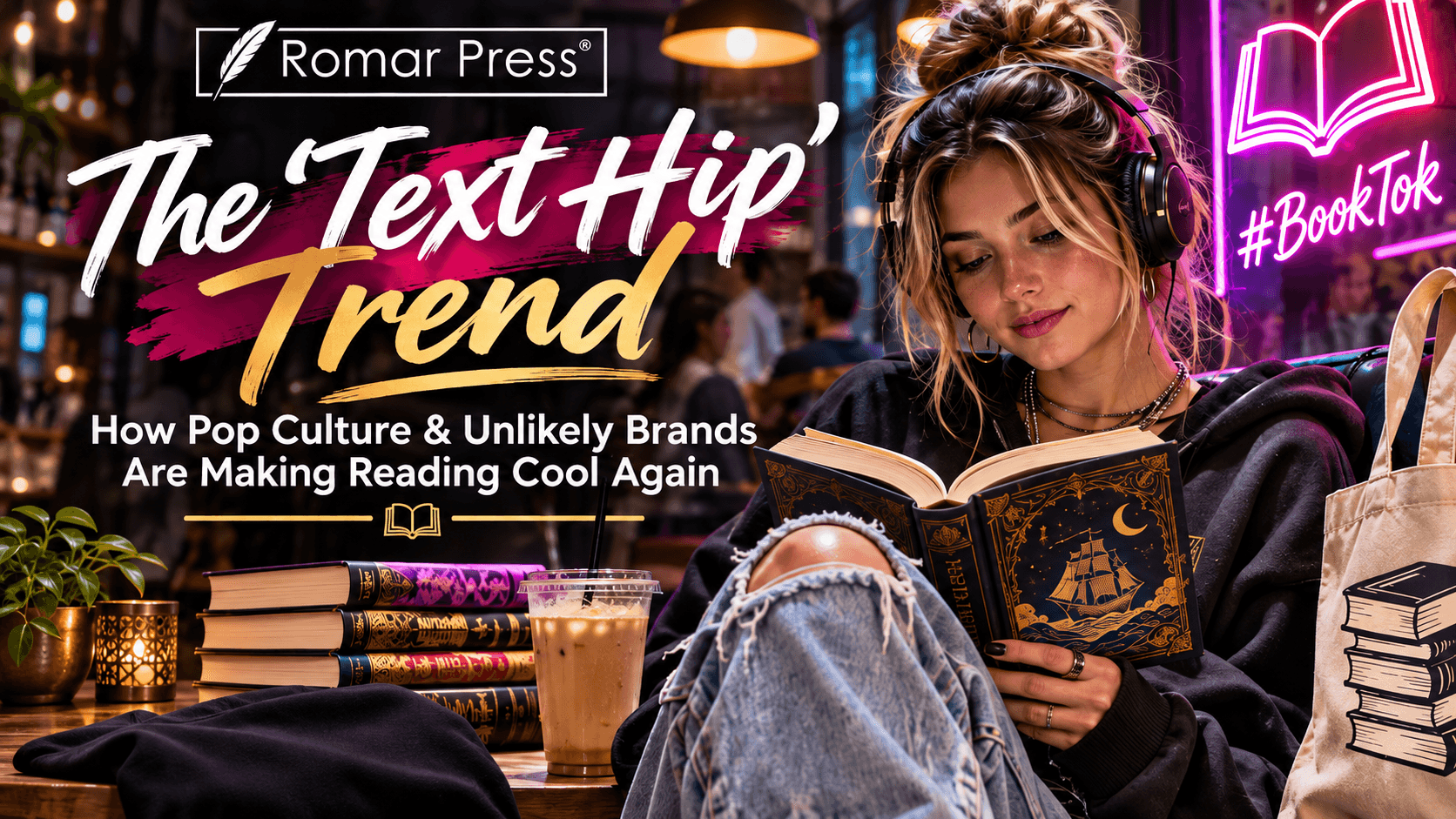
That one image sums up a shift we've been watching while helping ROMAR Press authors get their books in front of readers. Reading, for generations the quietest thing a person could do, has become something people wear, post, photograph and gather around. Call it the "text hip" moment. Books have broken out of the bookstore and into fashion, food, nightlife and social media, and the lessons for anyone who writes or publishes a book are practical ones.
From a quiet habit to a visible identity
For most of the last century, reading was private. You did it alone, in a chair, and nobody knew unless you told them. Social media changed that. On TikTok, the community known as BookTok turned reading into something you could perform: tearful reactions to endings, color-coordinated shelves, "books that broke me" lists, and annotated pages full of sticky tabs.
The effect on sales is real. Circana, which tracks U.S. print book sales, reported that sales by #BookTok authors grew nearly 20% in 2024, the fifth straight year of growth for that group. In 2025, Publishers Weekly credited BookTok with helping adult fiction grow again, while romance climbed 3.9% to almost 44 million copies. A single title, Rebecca Yarros's Onyx Storm, sold nearly 1.7 million.
Celebrities noticed. Dua Lipa runs a book club through her Service95 platform, and model Kaia Gerber started one, Library Science, aimed squarely at readers her age. Being seen with a book became a signal: I'm thoughtful, I have taste, I'm off my phone for a while.
And then reading went social in person. In New York, a series called Reading Rhythms hosts "reading parties": bring a book, read silently in timed blocks, talk with strangers between rounds, all over live music. Time Out reports it was founded in 2023 by four friends who missed pre-smartphone reading, and that past events drew waitlists in the hundreds. A survey by ThriftBooks found that 61% of Gen Z and millennial respondents would join a book club to make new friends.
The paradox behind the trend
Here's the part that rarely makes the highlight reel. A study from the University of Florida and University College London, published in iScience in August 2025, found that the share of Americans who read for pleasure on a given day fell from 28% in 2004 to 16% in 2023. Fewer people are reading, but the people who still read are reading for longer.
That isn't a contradiction. It's the reason the trend exists. When something becomes less common, doing it says more about you. Reading has become a small act of identity, and identity is exactly what brands know how to sell.
When brands discovered books
Over the last two years, some of the least likely companies in the world have built products around books. A few of the most instructive:
Coach and Penguin Random House: the book as jewelry
Coach's "Explore Your Story" campaign launched twelve miniature book charms, including Jane Austen's Sense and Sensibility and Maya Angelou's I Know Why the Caged Bird Sings. Penguin Random House partnered in the U.S., and independent publishers in China, Japan and Korea brought in their own authors. Coach said the campaign was inspired by a Gen Z return to long-form storytelling. Its chief marketing officer put the brand's role simply:
"Our role isn't to speak for communities, but to create shared spaces."
Dior: the first edition as a luxury canvas
When designer Jonathan Anderson took over at Dior, one of his first moves was a Book Cover Collection: the house's famous Book Tote, embroidered with renditions of 19th- and 20th-century first-edition covers. Madame Bovary, Ulysses, Bonjour Tristesse, and Dracula, a book close to home, since our partner ROMAR Press publishes it in its ROMAR Press Classics edition. The bags sell for thousands of dollars. The novels themselves cost a few dollars in paperback. The cover art carried the value.
Miu Miu: a fashion house that hosts a book club
Since 2024, Miu Miu has run a Literary Club in Milan. The April 2025 edition, "A Woman's Education," filled the city's oldest cultural society with talks on Simone de Beauvoir and Japanese novelist Fumiko Enchi, plus readings and live music, free with registration. That summer, the brand ran Summer Reads events in five cities, from Paris to Osaka. A luxury label is spending its marketing budget on literary criticism, and people are lining up for it.
T2 and Penguin: books you can steep
In Australia, tea company T2 and Penguin are on the third chapter of their collaboration: a "Little Library" of 36 tea bags packed into 12 tiny classic-book boxes, and gift sets that pair a novel in an exclusive T2 cover with a matching blend, like The Great Gatsby with New York Breakfast tea. It's a book sold as a ritual, not a product.
Penguin Random House and Online Ceramics: reading as a statement
Streetwear label Online Ceramics and Penguin Random House made "Reading Is a Right", tie-dye shirts and bumper stickers pushing back against book bans, with net proceeds going to the American Library Association's media literacy work. People bought a T-shirt to say what they believe about books.
The bookstore became a destination
Retail has followed the readers. Barnes & Noble, written off a decade ago, ended 2025 with 702 stores after three straight years of aggressive openings. Independent stores are growing even faster: the American Booksellers Association counted 605 new independent bookstores in 2025, including 399 storefronts, 106 pop-ups and 77 mobile shops, and its membership rose 19%.
Many of the new shops look more like third places than stores. A bookshop and cat café in Ocala, Florida. A romance bookstore-café pop-up in Los Altos, California, partnering with matcha carts. A fantasy-only shop built around book clubs and themed nights.
Publishers have leaned in too, with the book as a collectible object. Barnes & Noble has a whole section called "Judge a Book by Its Edges" for special editions with sprayed and stenciled edges, foil and bonus content. Readers buy a second copy of a book they already own because the edition itself is the point.
What publishers and authors can learn
The lesson isn't "get a Dior deal." It's that the most successful books right now are being treated as lifestyle products, not just media. Every one of these principles scales down to a small press and a first-time author.
- The cover is the product. Design for a phone screen, a shelf photo and a tote bag, not just a bookstore spine. If someone would want to be seen holding it, you've done half the marketing.
- Sell the experience around the book. A launch night, a reading at a coffee shop, a signing with music. People share experiences far more readily than they share purchases.
- Partner sideways. You don't need a fashion house. A local café, boutique, winery or bakery is your T2. Pair a book with something people already love in your town.
- Make the edition worth collecting. A signed first printing, a numbered run, a bookmark designed for the book. Small extras turn a purchase into a keepsake.
- Let readers make it theirs. Quote cards, book-club questions, a photo spot at your signing. Give people something to post that says something about them.
- Keep it real. Coach's charms work because they're real, readable books. Readers can tell the difference between a brand that loves books and one borrowing their look.
And underneath all of it, the oldest rule still holds: the book has to be good. BookTok runs on word of mouth, and word of mouth runs on a story someone couldn't put down.
At Tomorrow's Tech AI, we think about this every time we plan a launch for a ROMAR Press author. Reading is having a moment, and a well-made book from a real person, with a story worth telling, fits that moment perfectly. If you're working on a book and wondering how to get it into readers' hands, ROMAR Press would love to hear about it.
Topicsreading culture · booktok · book marketing · brand partnerships · bookstores
Filed underBook Marketing
Published by
Tomorrow's Tech AI Editorial Team
Tomorrow’s Tech AI runs marketing services for ROMAR Press authors: showcases, ads, outreach and more.
Marketing services →Book Marketing
Get your book in front of readers
ROMAR Press authors can add marketing services: showcases, ads, outreach and more.
Get the Journal by email
New posts on writing, publishing and the books we love, sent when they’re published. No spam, and you can unsubscribe in one click.