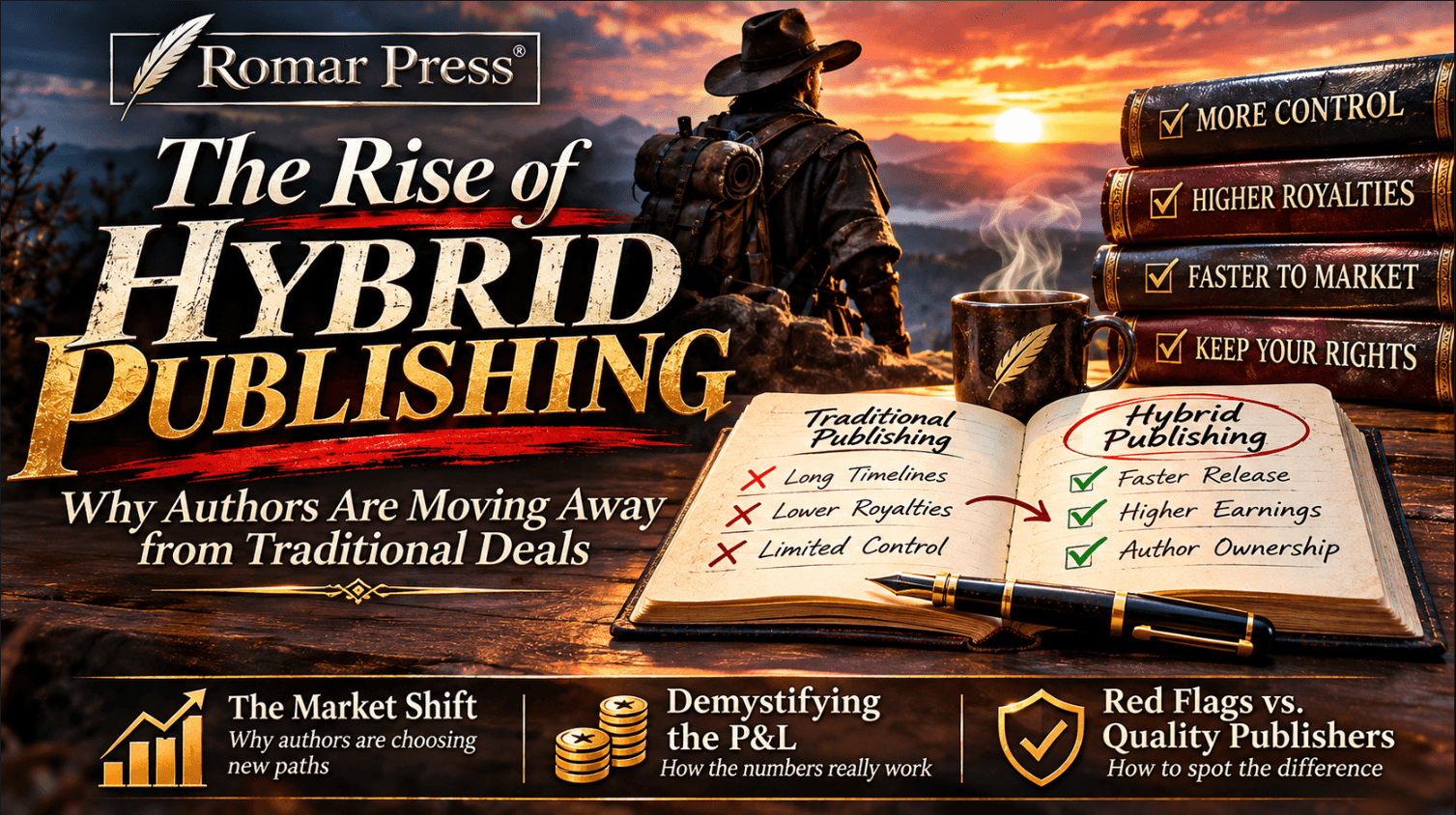
The Rise of Hybrid Publishing: Why Authors Are Moving Away from Traditional Deals
Self-published titles jumped almost 39% last year, and more writers are weighing a third path between a traditional deal and doing it all alone. Here's what's driving the shift, how the money actually works in each model, and how to tell a real hybrid publisher from a vanity press.
In this article
For most of the last century, there were two ways to get a book published. You found an agent, the agent found a publisher, and the publisher paid you an advance and took it from there. Or you paid a "vanity press" to print your book and hoped for the best.
That map has changed. Self-publishing grew into a serious industry, and between it and the traditional deal, a third option has grown up: hybrid publishing, where the author and the publisher both invest in the book and share in what it earns.
More writers are taking that middle path. Here's why, how the numbers work, and how to make sure the publisher you choose is the real thing.
The market shift
Authors are taking control
The clearest sign of the shift is volume. According to Bowker data reported by Publishers Weekly, more than 3.5 million self-published print and ebook titles were registered in the U.S. in 2025, up 38.7% in a single year. Traditionally published titles grew 6.6%, to about 642,000. (Bowker counts ISBNs, not unique books, and Publishers Weekly notes that AI-generated titles account for an unmeasured share of the jump. The direction is still clear.)
And independent books aren't just a long tail anymore. The best-selling print book in the U.S. so far this year, Theo of Golden, started life as a self-published novel by a first-time author before word of mouth carried it to the top of the charts.
Why writers are rethinking the traditional deal
A traditional contract still has real advantages: the publisher pays for everything, and you get an advance up front. But authors weighing their options keep running into the same three issues.
Time. Finding an agent can take months, selling the book can take months more, and once a deal is signed, publication is commonly 18 months to two years away. From first query to bookstore shelf, two to three years is normal.
Money. Traditional royalties are modest: commonly 10–15% of the cover price for hardcovers, about 7.5% for trade paperbacks, and around 25% of the publisher's net receipts for ebooks. And the advance is paid against those royalties, so you see no more money until the book earns it back. The Authors Guild's most recent income survey found that the median full-time author earned about $10,000 from books in a year. Full-time self-published authors did slightly better, at $12,800.
Control. In a traditional deal, the publisher usually has the final say on the cover, the title, the price and the timing, and it controls the rights you sign over for the length of the contract.
None of this makes traditional publishing a bad choice. For some books it's the best one. But for many writers, especially those with a clear audience, a local following or a story they want told their way, the trade-off no longer makes sense.
Demystifying the P&L: how the money really works
Every book is a small business with a profit and loss statement. Someone pays for editing, cover design, interior layout, printing and distribution. Someone takes the risk if the book doesn't sell. And everyone involved gets a cut of each copy that does. The three models just split those costs and cuts differently.
Traditional publishing. The publisher pays every cost and takes all of the risk. In return, it keeps most of the money from each sale and pays you a royalty. Your advance is a loan against future royalties: you keep it even if the book doesn't sell, but you won't see another check until it earns out.
Self-publishing. You pay every cost and take all of the risk, and you keep most of the money. On Amazon's KDP, for example, an ebook priced between $2.99 and $9.99 earns a 70% royalty, and a paperback has long earned 60% of its list price minus the printing cost. (Amazon's royalty calculator has the current rates.) The catch: you're also the editor-hirer, designer-finder, marketer and project manager, and many bookstores are reluctant to stock self-published titles.
Hybrid publishing. You and the publisher share the costs and the risk. You invest in professional services up front; the publisher brings the editing, design, production and distribution know-how, publishes the book under its own name, and pays you a royalty that should be higher than the traditional standard because you've shared the investment.
A simple example
Here's how one copy of a $17.99 paperback might work out. These are sample numbers to show the shape of each model, not anyone's actual terms.
- Traditional: at a 7.5% royalty, you earn about $1.35 per copy, after your advance has earned out. You paid nothing up front.
- Self-published on KDP: 60% of $17.99 is $10.79. If a 300-page paperback costs roughly $4.50 to print, you earn about $6.29 per Amazon sale, but you paid for editing, design and everything else yourself.
- Hybrid: you pay a project fee up front, and you earn a larger royalty than a traditional deal would pay. The exact split depends on your contract, which is why reading it carefully matters.
The right choice depends on what you value most: no upfront cost, the highest earnings per copy, or professional help without giving up your rights.
Red flags vs. quality publishers
Here's the problem: "hybrid" isn't a regulated word. Anyone can use it, and many vanity presses do. Writer Beware, the publishing watchdog run by the Science Fiction and Fantasy Writers Association, warns that a company calling itself hybrid deserves extra scrutiny for exactly that reason.
To fix this, the Independent Book Publishers Association published standards for what a legitimate hybrid publisher should do, revised in 2022 to eleven points. The IBPA's position is that a publisher should meet all of them before calling itself hybrid. A real hybrid publisher:
- Has a defined mission and vision for what it publishes.
- Vets submissions, which means it turns some books down.
- Is transparent and truthful in its business practices.
- Offers a negotiable, plainly worded contract for each book.
- Publishes under its own imprint and ISBNs.
- Publishes to industry standards.
- Delivers professional editing, design and production.
- Pursues and manages a range of publishing rights.
- Provides distribution.
- Demonstrates respectable sales.
- Pays authors a better-than-standard royalty.
Red flags to watch for
- They accept everything. If no manuscript is ever turned down, the business is selling services, not publishing books.
- They make money only from authors. A real hybrid earns from both author fees and book sales, so it has a reason to sell your book.
- The contract is vague, or you're pushed to sign fast. You should be able to see exactly what you're paying, what you get, and what happens to your rights, in writing, with time to think.
- They want your copyright. You should keep the copyright to your own work.
- "Marketing packages" that promise the moon. Guaranteed bestseller status, paid "reviews," film-pitch fees. Real publishers don't sell guarantees.
- No real distribution. Ask exactly where your book will be available and how bookstores and libraries can order it.
Questions to ask before you sign
- Do you turn manuscripts down, and why?
- What exactly does my fee cover, and what costs extra?
- Who owns the copyright, and what rights am I granting you, for how long?
- What royalty will I earn on each format, and is it on the list price or net?
- Where will my book be sold, and how do I see my sales?
- Can I talk to some of your authors?
And whoever you're considering, read Writer Beware's guide to small presses and vanity publishers, and have someone you trust, ideally a lawyer, read the contract before you sign it.
Where ROMAR Press fits
ROMAR Press describes itself on its own site as an independent hybrid publisher, and says plainly that it is not a vanity press. Here's how it works, in ROMAR's own published terms:
- Authors keep their copyright. ROMAR manages the technical and production side of publishing.
- Costs are quoted for each project, based on the services your book needs and its final retail price, and set out in a written Service Schedule before any work begins.
- The author's investment is stated up front, including a commitment to purchase 50 copies of your book at 25% off the retail price.
- You're paid royalties on your book.
- The first consultation is free.
You can read the details on ROMAR's Publish page and in its author FAQ.
The path from manuscript to bookshelf has more options than ever, and that's good news for writers. Whichever route you choose, choose it with your eyes open, your rights protected and your contract read. If you're weighing your options and want to talk them through, ROMAR Press would love to hear about your book.
Topicshybrid publishing · self-publishing · traditional publishing · author rights · royalties
Filed underPublishing
Published by
Tomorrow's Tech AI Editorial Team
Tomorrow’s Tech AI runs marketing services for ROMAR Press authors: showcases, ads, outreach and more.
Marketing services →Publishing
Have a book in you?
Tell us about it. Your first consultation with ROMAR Press is free.
Get the Journal by email
New posts on writing, publishing and the books we love, sent when they’re published. No spam, and you can unsubscribe in one click.